We Have Saved International Investors Over $5,000,000 from Bad Franchise Investments

We Have Saved International Investors Over $5,000,000 from Bad Franchise Investments. Here Is How.
I receive a version of the same call every few months. An international investor has already paid a franchise fee. The brand looked great online. The broker was enthusiastic. But now, six months in, the unit is losing money, the franchisor is unreachable, and the visa renewal is in jeopardy.
These calls are the reason we built the due diligence process we have today.
Since 2015, our team at Visa Franchise has analyzed well over 1,000 franchise brands on behalf of E-2 and EB-5 investors. We have approved many of them. But we have also walked away from a significant number. This article is about some of the ones we walked away from, what we found, and what it means for anyone considering a franchise investment in the United States.
The Stakes Are Different for International Investors
For most Americans buying a franchise, a bad investment means financial pain. It costs them money, time, and stress. That is serious enough. But for an international investor on an E-2 visa, the stakes are higher. The investment is tied to their legal status. If the business fails, the visa fails with it. The family may have to leave the country.
This is why we do not simply point clients toward franchise brands and collect a referral fee. We analyze every brand before a client ever sees it. And when a brand does not pass, it does not reach our clients at all.
Over $5 million in estimated avoided losses across our client base did not happen by accident. It happened because we built a systematic, documented process for catching what looks good on the surface but is broken underneath.
A bad franchise investment does not just cost an international investor money. It can cost them their visa, their family's legal status, and years of planning.
How We Analyze a Franchise Brand
Every brand that enters our review pipeline goes through three tiers of analysis. None of this is outsourced. Our internal team does the work.
%201.07.10%E2%80%AFa.%C2%A0m..png)
Tier 1: Full FDD Review
The Franchise Disclosure Document is the legal foundation of any franchise investment. It runs 200 to 400 pages and most buyers never read it carefully. We read all of it, every time.
- Items 1 and 2: Who founded this company, what did they do before, and did any of those prior ventures end badly
- Item 3: All disclosed litigation, filed, pending, and settled
- Item 4: Bankruptcy history of the franchisor and its principals
- Item 6: Royalties, advertising fees, transfer fees, and anything else the franchisee will pay on an ongoing basis
- Item 7: Total initial investment and whether any line items look unusual
- Item 19: Financial Performance Representations, and critically, whether the franchisor chose to disclose them at all
- Item 20: Unit count history, how many opened, how many closed, how many were terminated, how many transferred
- Item 21: Audited financial statements of the franchisor
Tier 2: Enhanced Financial Review
The FDD tells us what the franchisor is required to disclose. We go further.
- Income statements for the current year and two prior years
- Balance sheet analysis, total assets, cash on hand, and liability structure
- Long-term debt levels and whether they are growing or declining
- Cash flow statements and any year-over-year deterioration
- Individual unit performance data where available
Tier 3: Independent Research
Numbers only tell part of the story. We research the brand and its leadership independently.
- Google searches on every principal through the third page, specifically checking for lawsuit, litigation, and dispute
- News coverage, Better Business Bureau complaints, and Yelp review patterns
- Direct calls with existing franchisees when possible
- Franchise evaluation criteria covering territory rights, renewal terms, post-termination protections, and sourcing restrictions
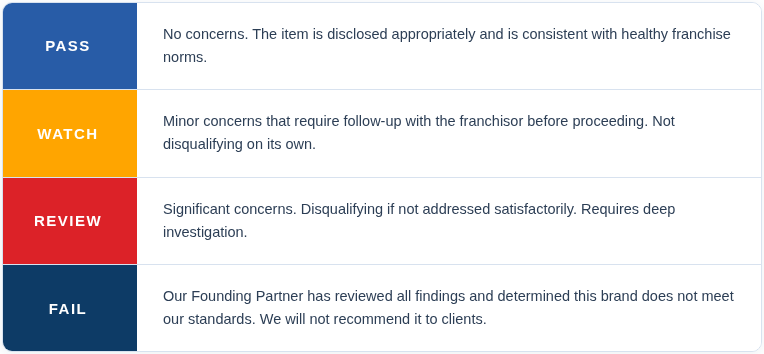
Our Four-Level Rating System
Every item in our review gets one of four ratings. There is no ambiguity in our process.
12 Brands We Did Not Approve
Since 2015, our team has conducted over 1,000 franchise due diligence reviews. Below are twelve examples where we identified serious concerns that led to a Watch, Review, or Fail verdict. Across all of our reviews, we have documented more than 250 individual red flags. We have withheld brand names. Industries and findings are shared in full.
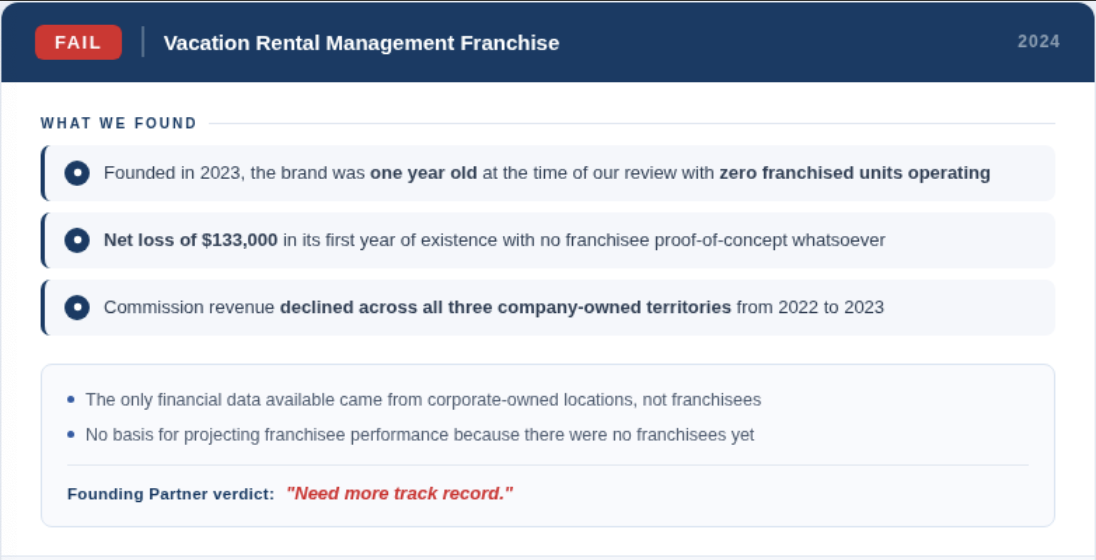
1. Vacation Rental Management Franchise: Zero Franchised Units and $133K Net Loss in Year One
2 Juice and Health Cafe Franchise Red Flag: Securities Fraud History and No Item 19 Disclosure
A juice and health cafe franchise that failed Visa Franchise's 2024 review due to the president's securities fraud background, active litigation disclosed in Item 3, and only 7 total units with no earnings data for prospective investors.
%202.13.14%E2%80%AFp.%C2%A0m..png)
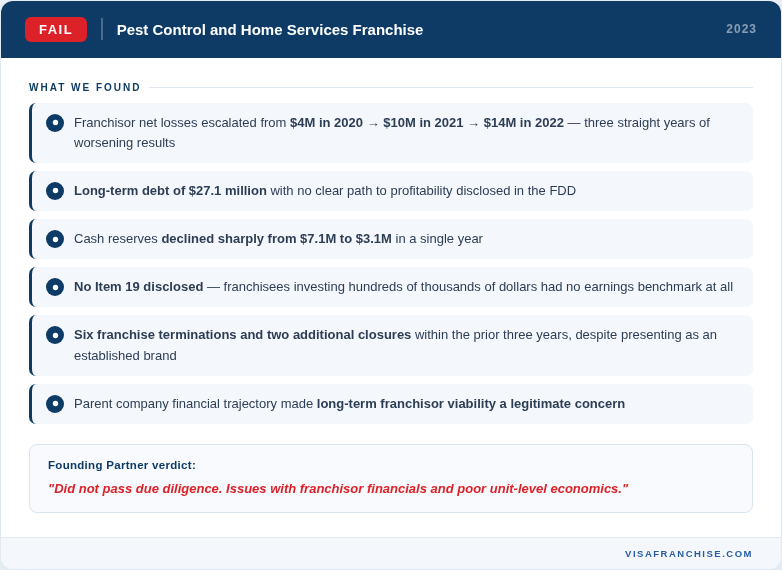
3. Pest Control and Home Services Franchise: $14M Net Loss and $27M Long-Term Debt in Pest Control Franchise
Visa Franchise's 2023 due diligence review of a pest control franchise reveals three consecutive years of worsening losses, $27.1M in long-term debt, rapid cash reserve decline, and six franchise terminations. All without an Item 19 disclosure.
4. Assisted Stretching and Wellness Franchise: Litigious Founder and 70% Cash Flow Drop
An assisted stretching franchise failed Visa Franchise's 2023 review after independent research revealed a highly litigious founder, more than half the 11-unit system closing or being absorbed, and a 70% single-year decline in cash flow.

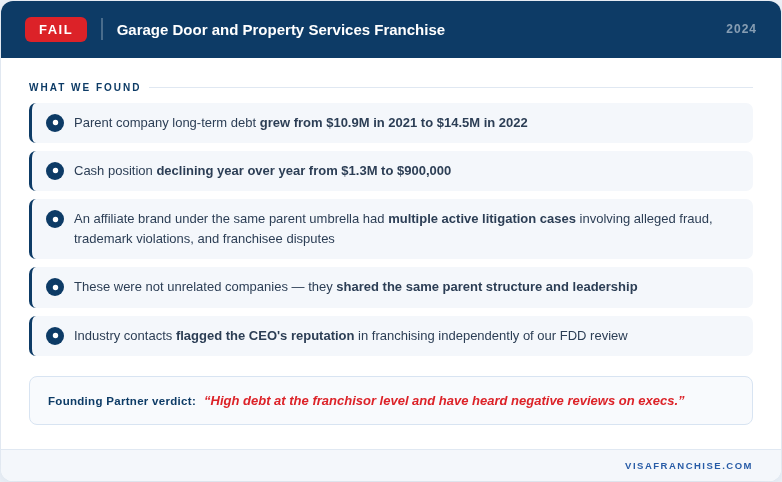
5. Garage Door and Property Services Franchise: Rising Debt, CEO Reputation Issues, and Affiliate Litigation
A garage door and property services franchise flagged in 2024 for growing long-term debt, declining cash position, multiple active litigation cases within its affiliated brand, and independently verified concerns about executive reputation in franchising.
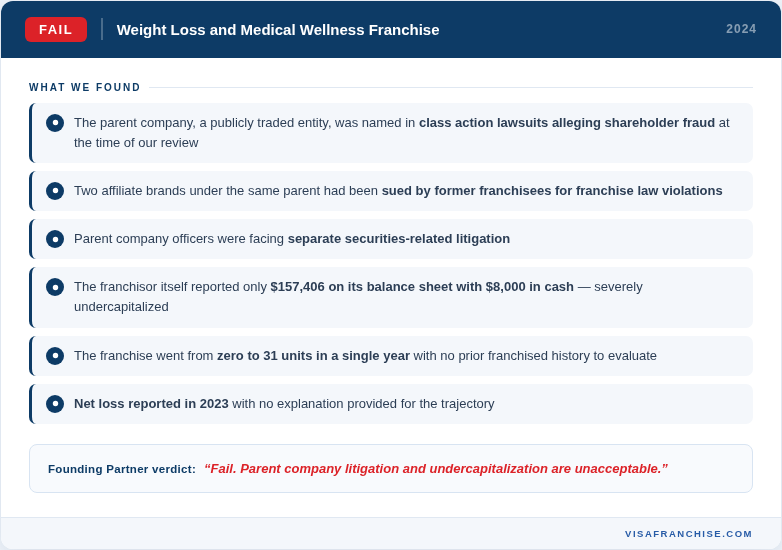
6. Weight Loss and Medical Wellness Franchise: $8K Cash and Active Shareholder Lawsuits
Visa Franchise's 2024 review of a weight loss and medical wellness franchise reveals a parent company named in class action suits, $8,000 in franchisor cash reserves, securities litigation against officers, and 31 units opened in one year with no track record.
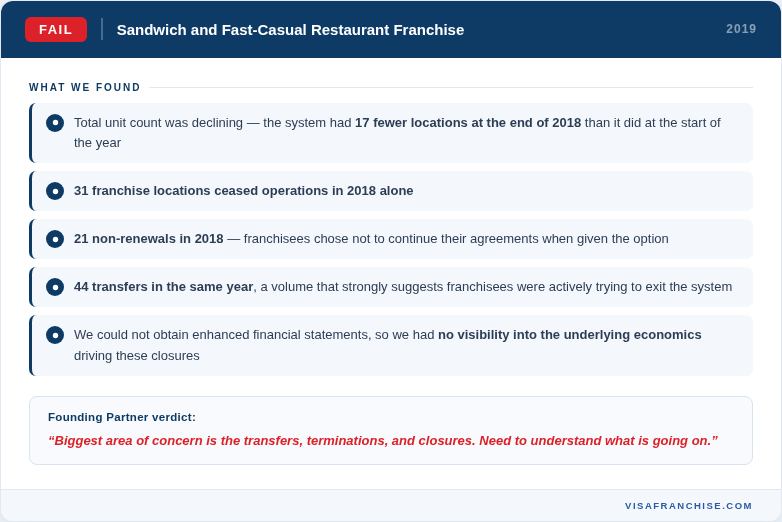
7. Sandwich and Fast-Casual Restaurant Franchise: 31 Closures, 44 Transfers, and 21 Non-Renewals in a Single Year
A fast-casual sandwich franchise reviewed by Visa Franchise in 2019 showed a system actively shrinking. 17 fewer locations year over year, mass non-renewals, and a transfer volume indicating franchisees were trying to exit as fast as possible.
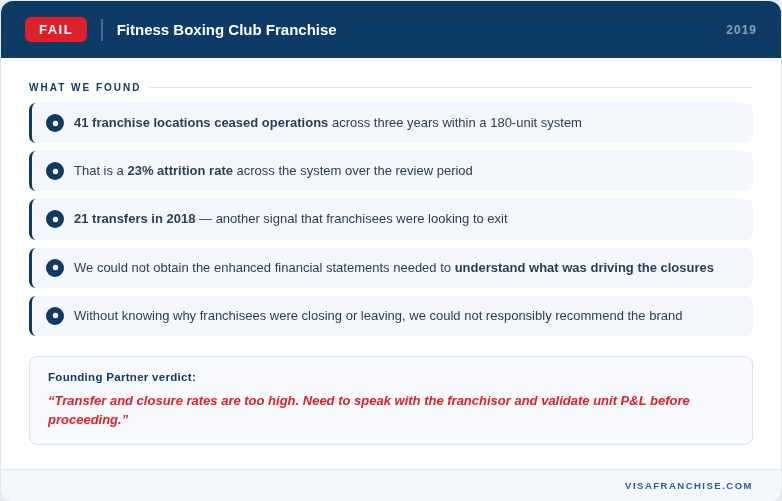
8. Fitness Boxing Club Franchise: Why This Fitness Franchise Failed Our Due Diligence in 2019
A fitness boxing franchise with 41 closures across three years and a 23% attrition rate failed Visa Franchise's review. Without access to enhanced financials, the underlying cause of closures could not be determined, making a recommendation impossible.
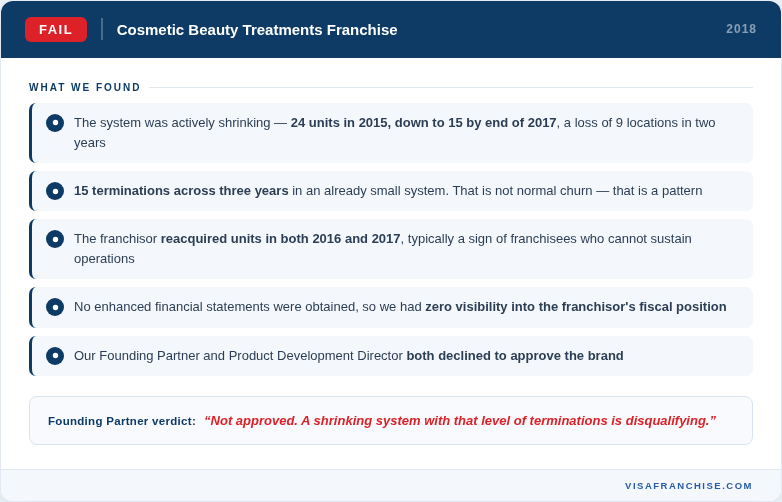
9. Cosmetic Beauty Treatments Franchise: 15 Terminations and 9 Lost Locations in Two Years
Visa Franchise's 2018 review of a cosmetic beauty treatments franchise found a system actively contracting, from 24 to 15 units in two years, 15 terminations, and franchisor reacquisitions signaling franchisees unable to sustain operations.
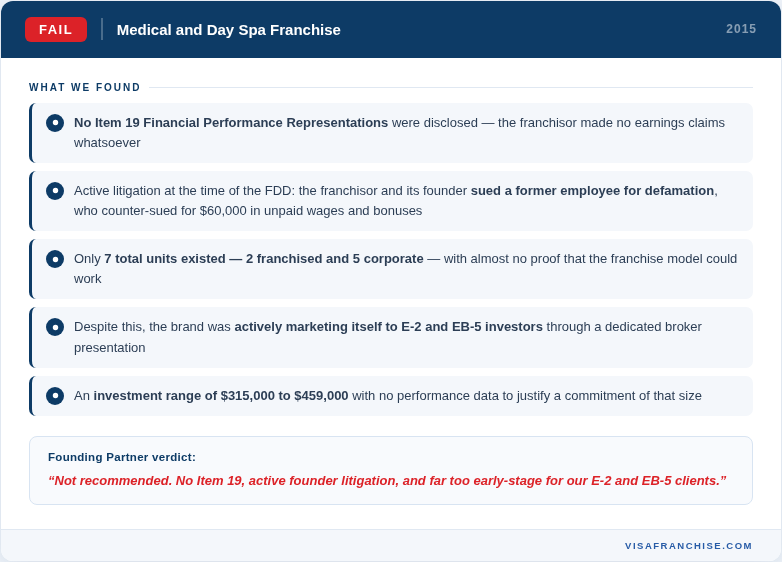
10. Medical and Day Spa Francise: Medical Spa Franchise With Active Litigation and No Item 19
A medical and day spa franchise reviewed by Visa Franchise in 2015 was rejected for E-2 and EB-5 clients due to no Item 19 disclosure, active defamation litigation against the founder, only 2 franchised units, and an investment ask of up to $459,000 with zero performance data.
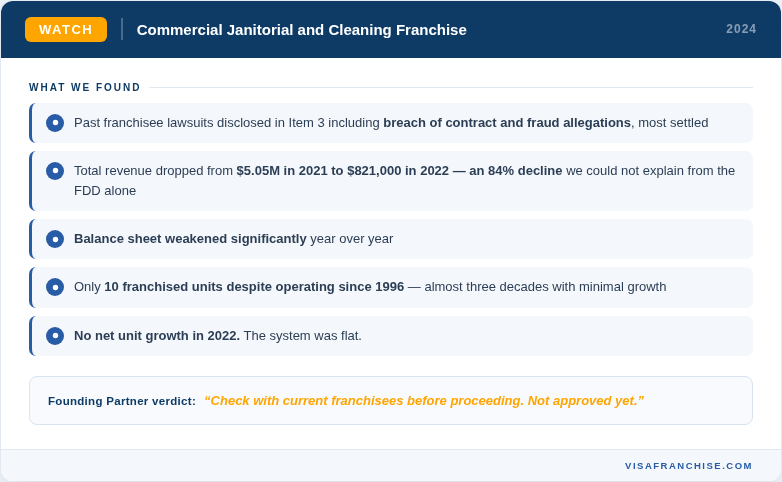
11. Commercial Janitorial and Cleaning Franchise: 84% Revenue Drop and Stagnant Unit Growth Since 1996
A commercial janitorial franchise placed under Watch status in Visa Franchise's 2024 review due to an unexplained 84% revenue decline, a weakening balance sheet, prior franchisee litigation, and only 10 units after nearly three decades of operation.
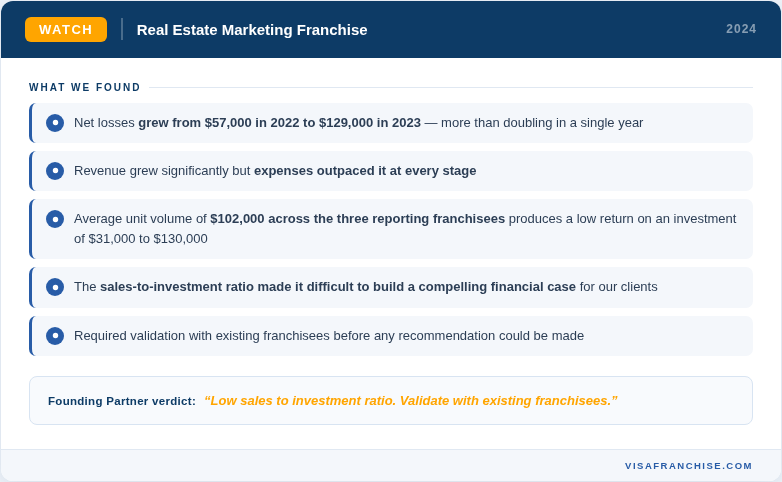
12. Real Estate Marketing Franchise: $102K Average Unit Volume on a $130K Investment
Visa Franchise placed a real estate marketing franchise on Watch in 2024 after finding net losses more than doubled year-over-year and average unit revenues produced a weak return relative to the investment range, requiring franchisee validation before any recommendation.
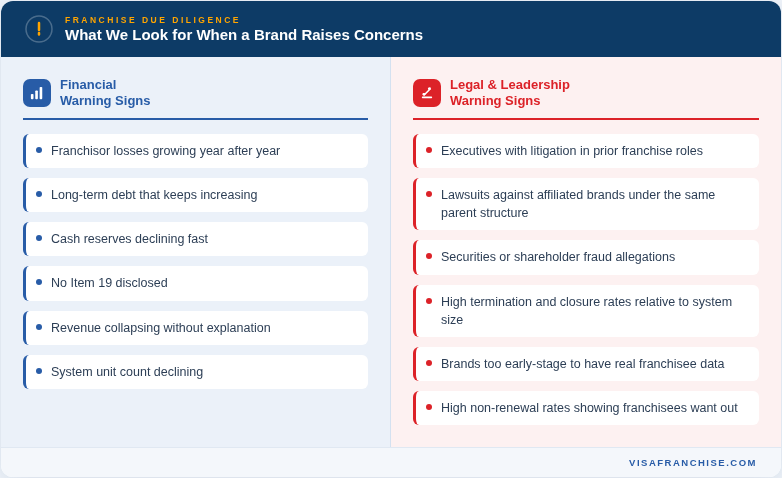
What These 12 Reviews Have in Common
Looking across every analysis above, the same warning signs appear over and over. These are the patterns that most reliably predict a franchise brand that will hurt our clients.
What $5 Million in Avoided Losses Actually Means
Let me be straightforward about how we calculate this.
The average initial investment across the twelve brands above ranges from roughly $65,000 to $500,000. If even one client per analysis had invested without our review, the capital at risk is well over $5 million. That is a conservative number. Multiple clients often express interest in the same brand at the same time.
But the financial number understates the real cost of a bad franchise for an international investor. Consider what else is at stake:
- Visa petition costs and legal fees if the business fails and the visa comes up for renewal
- Working capital losses during the first one to two years of operating a struggling franchise
- The opportunity cost of capital tied up in an investment that will not deliver a return
- The personal cost of uprooting a family for a business that does not work
For an E-2 investor, the business is not separate from the visa. When the business fails, so does the immigration plan. That is a categorically different risk than what a U.S.-based investor faces.
The Brands We Did Approve
Our standards exist to make our approvals meaningful. The brands we recommend to clients share consistent characteristics that our failed analyses largely lack.
- A proven track record, typically five or more years of franchising with real franchisee performance data
- Item 19 disclosures with average unit volumes supported by audited or verified franchisee numbers
- Clean litigation history, no pattern of franchisee suits, no executive fraud history, no securities issues
- Healthy franchisor financials, positive or improving income, manageable debt, growing cash position
- Franchisee satisfaction confirmed through direct conversations, not just what the franchisor tells us
- Growing unit counts with termination and closure rates that reflect normal business turnover, not systemic failure
When we place a client in a franchise, they are not guessing. They are investing with evidence.
What This Means for You
If you are an international investor or entrepreneur considering a franchise investment as part of an E-2 or EB-5 visa application, here is my direct advice.
Read the FDD yourself. All of it. Pay particular attention to Item 3 (litigation), Item 19 (earnings data), Item 20 (unit history), and Item 21 (financial statements). If a franchisor does not disclose Item 19, ask them why in writing and see how they respond.
Do not rely on the franchisor's validation calls alone. The franchisees they connect you with are handpicked. Ask for the full list from Item 20 and call franchisees who are not on their suggested list.
Be skeptical of brands marketed specifically to visa investors. Several of the brands above actively targeted E-2 and EB-5 buyers. That targeting is not a sign of a strong business. In some cases it is a sign that domestic buyers are not buying.
Work with someone who has reviewed hundreds of FDDs, not just read about them. Pattern recognition matters enormously in this process. The first time you read an FDD, you do not know what normal looks like. By the hundredth time, the problems jump off the page.
Frequently Asked Questions
What is franchise due diligence?
Franchise due diligence is the process of independently verifying the financial, legal, and operational claims a franchisor makes before you sign a franchise agreement or commit capital. At minimum it covers a review of the Franchise Disclosure Document, direct outreach to current and former franchisees, and an independent financial assessment. For visa investors, it also includes confirming that the franchise meets USCIS investment thresholds and operational requirements.
How long does franchise due diligence take?
Thorough franchise due diligence takes 3 to 6 weeks. The FDD alone runs 200+ pages. Item 19 financial performance representations require external verification. Franchisee validation calls (speaking with 5 to 10 current owners, not the ones the franchisor recommends) take time to schedule. Rushing the process is the most common mistake international investors make.
What is in the Franchise Disclosure Document (FDD)?
The FDD has 23 mandatory disclosure items, set by the FTC Franchise Rule. The most important for investors are Item 19 (financial performance representations), Item 20 (franchisee outlet counts and contact information, including former franchisees), and Item 21 (audited financial statements). Many franchisors leave Item 19 blank. That is a legal choice, but it means they are not showing you any earnings data.
How much does franchise due diligence cost?
A professional franchise due diligence review typically ranges from $2,500 to $6,000 depending on depth. Most E-2 franchise opportunities require $100,000 to $500,000 in total capital. A $3,000 review on a $200,000 investment is 1.5% of your total at-risk capital.
What percentage of franchises fail?
Failure rates vary significantly by brand, sector, and how failure is defined. Item 20 of the FDD discloses how many locations transferred, were terminated, or did not renew in the past three years. A system where more than 10% of locations closed or changed hands in three years warrants a specific explanation before you proceed. Aggregate national statistics blend too many variables to be useful for evaluating a single brand.
Can I do franchise due diligence without a lawyer or advisor?
You can review the FDD yourself. The FTC publishes a consumer guide to buying a franchise. But Item 19 financial analysis, franchisee validation call design, and territory viability assessment require specialized knowledge most investors don't have. For E-2 visa investors, a bad franchise selection carries immigration consequences in addition to financial ones. Independent professional review does not eliminate risk; it reduces the probability of an avoidable mistake.
What makes a franchise a poor fit for an E-2 visa investment?
Four conditions disqualify most applications at the USCIS level: the investment falls below the substantiality threshold for your treaty country (generally $100,000 to $150,000 minimum), the business is passive rather than owner-operated, projected revenue cannot demonstrate your ability to develop and direct the enterprise, or the model does not create U.S. jobs beyond your own position. The franchise itself may be profitable. The problem is that it does not satisfy visa-specific requirements.
Conclusion
Most of the $5,000,000 we protected for clients came from tiers 2 and 3. The FDD is a starting point, not a finish line. Item 19 financial projections need independent verification. Territory saturation is not disclosed anywhere in the document. Franchisee exit rates don't appear in the standard tables.
The 12 brands we rejected all passed tier 1. Every one of them. The problems surfaced when we called franchisees directly, cross-referenced failure rates, or stress-tested the unit economics against what the visa application actually requires.
If you are evaluating a franchise for an E-2 or EB-5 investment, you should not be doing this alone. A franchise that fails to meet USCIS substantiality requirements does not just cost you money, it can cost you the visa.
2 Juice and Health Cafe Franchise Red Flag: Securities Fraud History and No Item 19 Disclosure
A juice and health cafe franchise that failed Visa Franchise's 2024 review due to the president's securities fraud background, active litigation disclosed in Item 3, and only 7 total units with no earnings data for prospective investors.
3. Pest Control and Home Services Franchise: $14M Net Loss and $27M Long-Term Debt in Pest Control Franchise
Visa Franchise's 2023 due diligence review of a pest control franchise reveals three consecutive years of worsening losses, $27.1M in long-term debt, rapid cash reserve decline, and six franchise terminations. All without an Item 19 disclosure.
4. Assisted Stretching and Wellness Franchise: Litigious Founder and 70% Cash Flow Drop
An assisted stretching franchise failed Visa Franchise's 2023 review after independent research revealed a highly litigious founder, more than half the 11-unit system closing or being absorbed, and a 70% single-year decline in cash flow.
5. Garage Door and Property Services Franchise: Rising Debt, CEO Reputation Issues, and Affiliate Litigation
A garage door and property services franchise flagged in 2024 for growing long-term debt, declining cash position, multiple active litigation cases within its affiliated brand, and independently verified concerns about executive reputation in franchising.
6. Weight Loss and Medical Wellness Franchise: $8K Cash and Active Shareholder Lawsuits
Visa Franchise's 2024 review of a weight loss and medical wellness franchise reveals a parent company named in class action suits, $8,000 in franchisor cash reserves, securities litigation against officers, and 31 units opened in one year with no track record.
7. Sandwich and Fast-Casual Restaurant Franchise: 31 Closures, 44 Transfers, and 21 Non-Renewals in a Single Year
A fast-casual sandwich franchise reviewed by Visa Franchise in 2019 showed a system actively shrinking. 17 fewer locations year over year, mass non-renewals, and a transfer volume indicating franchisees were trying to exit as fast as possible.
8. Fitness Boxing Club Franchise: Why This Fitness Franchise Failed Our Due Diligence in 2019
A fitness boxing franchise with 41 closures across three years and a 23% attrition rate failed Visa Franchise's review. Without access to enhanced financials, the underlying cause of closures could not be determined, making a recommendation impossible.
9. Cosmetic Beauty Treatments Franchise: 15 Terminations and 9 Lost Locations in Two Years
Visa Franchise's 2018 review of a cosmetic beauty treatments franchise found a system actively contracting, from 24 to 15 units in two years, 15 terminations, and franchisor reacquisitions signaling franchisees unable to sustain operations.
10. Medical and Day Spa Francise: Medical Spa Franchise With Active Litigation and No Item 19
A medical and day spa franchise reviewed by Visa Franchise in 2015 was rejected for E-2 and EB-5 clients due to no Item 19 disclosure, active defamation litigation against the founder, only 2 franchised units, and an investment ask of up to $459,000 with zero performance data.
11. Commercial Janitorial and Cleaning Franchise: 84% Revenue Drop and Stagnant Unit Growth Since 1996
A commercial janitorial franchise placed under Watch status in Visa Franchise's 2024 review due to an unexplained 84% revenue decline, a weakening balance sheet, prior franchisee litigation, and only 10 units after nearly three decades of operation.
12. Real Estate Marketing Franchise: $102K Average Unit Volume on a $130K Investment
Visa Franchise placed a real estate marketing franchise on Watch in 2024 after finding net losses more than doubled year-over-year and average unit revenues produced a weak return relative to the investment range, requiring franchisee validation before any recommendation.
What These 12 Reviews Have in Common
Looking across every analysis above, the same warning signs appear over and over. These are the patterns that most reliably predict a franchise brand that will hurt our clients.
What $5 Million in Avoided Losses Actually Means
Let me be straightforward about how we calculate this.
The average initial investment across the twelve brands above ranges from roughly $65,000 to $500,000. If even one client per analysis had invested without our review, the capital at risk is well over $5 million. That is a conservative number. Multiple clients often express interest in the same brand at the same time.
But the financial number understates the real cost of a bad franchise for an international investor. Consider what else is at stake:
- Visa petition costs and legal fees if the business fails and the visa comes up for renewal
- Working capital losses during the first one to two years of operating a struggling franchise
- The opportunity cost of capital tied up in an investment that will not deliver a return
- The personal cost of uprooting a family for a business that does not work
For an E-2 investor, the business is not separate from the visa. When the business fails, so does the immigration plan. That is a categorically different risk than what a U.S.-based investor faces.
The Brands We Did Approve
Our standards exist to make our approvals meaningful. The brands we recommend to clients share consistent characteristics that our failed analyses largely lack.
- A proven track record, typically five or more years of franchising with real franchisee performance data
- Item 19 disclosures with average unit volumes supported by audited or verified franchisee numbers
- Clean litigation history, no pattern of franchisee suits, no executive fraud history, no securities issues
- Healthy franchisor financials, positive or improving income, manageable debt, growing cash position
- Franchisee satisfaction confirmed through direct conversations, not just what the franchisor tells us
- Growing unit counts with termination and closure rates that reflect normal business turnover, not systemic failure
When we place a client in a franchise, they are not guessing. They are investing with evidence.
What This Means for You
If you are an international investor or entrepreneur considering a franchise investment as part of an E-2 or EB-5 visa application, here is my direct advice.
Read the FDD yourself. All of it. Pay particular attention to Item 3 (litigation), Item 19 (earnings data), Item 20 (unit history), and Item 21 (financial statements). If a franchisor does not disclose Item 19, ask them why in writing and see how they respond.
Do not rely on the franchisor's validation calls alone. The franchisees they connect you with are handpicked. Ask for the full list from Item 20 and call franchisees who are not on their suggested list.
Be skeptical of brands marketed specifically to visa investors. Several of the brands above actively targeted E-2 and EB-5 buyers. That targeting is not a sign of a strong business. In some cases it is a sign that domestic buyers are not buying.
Work with someone who has reviewed hundreds of FDDs, not just read about them. Pattern recognition matters enormously in this process. The first time you read an FDD, you do not know what normal looks like. By the hundredth time, the problems jump off the page.
Frequently Asked Questions
What is franchise due diligence?
Franchise due diligence is the process of independently verifying the financial, legal, and operational claims a franchisor makes before you sign a franchise agreement or commit capital. At minimum it covers a review of the Franchise Disclosure Document, direct outreach to current and former franchisees, and an independent financial assessment. For visa investors, it also includes confirming that the franchise meets USCIS investment thresholds and operational requirements.
How long does franchise due diligence take?
Thorough franchise due diligence takes 3 to 6 weeks. The FDD alone runs 200+ pages. Item 19 financial performance representations require external verification. Franchisee validation calls (speaking with 5 to 10 current owners, not the ones the franchisor recommends) take time to schedule. Rushing the process is the most common mistake international investors make.
What is in the Franchise Disclosure Document (FDD)?
The FDD has 23 mandatory disclosure items, set by the FTC Franchise Rule. The most important for investors are Item 19 (financial performance representations), Item 20 (franchisee outlet counts and contact information, including former franchisees), and Item 21 (audited financial statements). Many franchisors leave Item 19 blank. That is a legal choice, but it means they are not showing you any earnings data.
How much does franchise due diligence cost?
A professional franchise due diligence review typically ranges from $2,500 to $6,000 depending on depth. Most E-2 franchise opportunities require $100,000 to $500,000 in total capital. A $3,000 review on a $200,000 investment is 1.5% of your total at-risk capital.
What percentage of franchises fail?
Failure rates vary significantly by brand, sector, and how failure is defined. Item 20 of the FDD discloses how many locations transferred, were terminated, or did not renew in the past three years. A system where more than 10% of locations closed or changed hands in three years warrants a specific explanation before you proceed. Aggregate national statistics blend too many variables to be useful for evaluating a single brand.
Can I do franchise due diligence without a lawyer or advisor?
You can review the FDD yourself. The FTC publishes a consumer guide to buying a franchise. But Item 19 financial analysis, franchisee validation call design, and territory viability assessment require specialized knowledge most investors don't have. For E-2 visa investors, a bad franchise selection carries immigration consequences in addition to financial ones. Independent professional review does not eliminate risk; it reduces the probability of an avoidable mistake.
What makes a franchise a poor fit for an E-2 visa investment?
Four conditions disqualify most applications at the USCIS level: the investment falls below the substantiality threshold for your treaty country (generally $100,000 to $150,000 minimum), the business is passive rather than owner-operated, projected revenue cannot demonstrate your ability to develop and direct the enterprise, or the model does not create U.S. jobs beyond your own position. The franchise itself may be profitable. The problem is that it does not satisfy visa-specific requirements.
Conclusion
Most of the $5,000,000 we protected for clients came from tiers 2 and 3. The FDD is a starting point, not a finish line. Item 19 financial projections need independent verification. Territory saturation is not disclosed anywhere in the document. Franchisee exit rates don't appear in the standard tables.
The 12 brands we rejected all passed tier 1. Every one of them. The problems surfaced when we called franchisees directly, cross-referenced failure rates, or stress-tested the unit economics against what the visa application actually requires.
If you are evaluating a franchise for an E-2 or EB-5 investment, you should not be doing this alone. A franchise that fails to meet USCIS substantiality requirements does not just cost you money, it can cost you the visa.
Descubre si calificas para invertir en una franquicia próspera en EE. UU. y obtener tu visa E-2.
Verifica tu elegibilidad
More Insights You Might Like
Explore related articles packed with expert advice, real stories, and practical tips to support your U.S. visa and relocation journey.