7 Business Types That Fail the E-2 Visa Investment Test

Every week, I speak with international investors who have their hearts set on a business that will never qualify them for an E-2 visa. Sometimes they already know and are hoping I will tell them otherwise. Sometimes they are genuinely surprised.
The E-2 visa requires a substantial investment in a real, operating enterprise. The investment must be at risk. The business must create jobs. And in practice, the U.S. consulate officer reviewing your petition is going to scrutinize whether your investment is proportional to the business and whether your role as owner genuinely drives the enterprise.
Most of the businesses below fail on one or more of those tests. Some fail on all of them. A few have narrow exceptions, which I will note. But in the vast majority of cases, if you are an international investor or entrepreneur pursuing an E-2 visa, these are businesses to avoid.
The E-2 visa is not just about putting money into a business. It is about investing in a real, job-creating enterprise that you actively direct. Some businesses make that case almost impossible to make.
The 7 Business Types That Consistently Fail E-2 Visa Screening
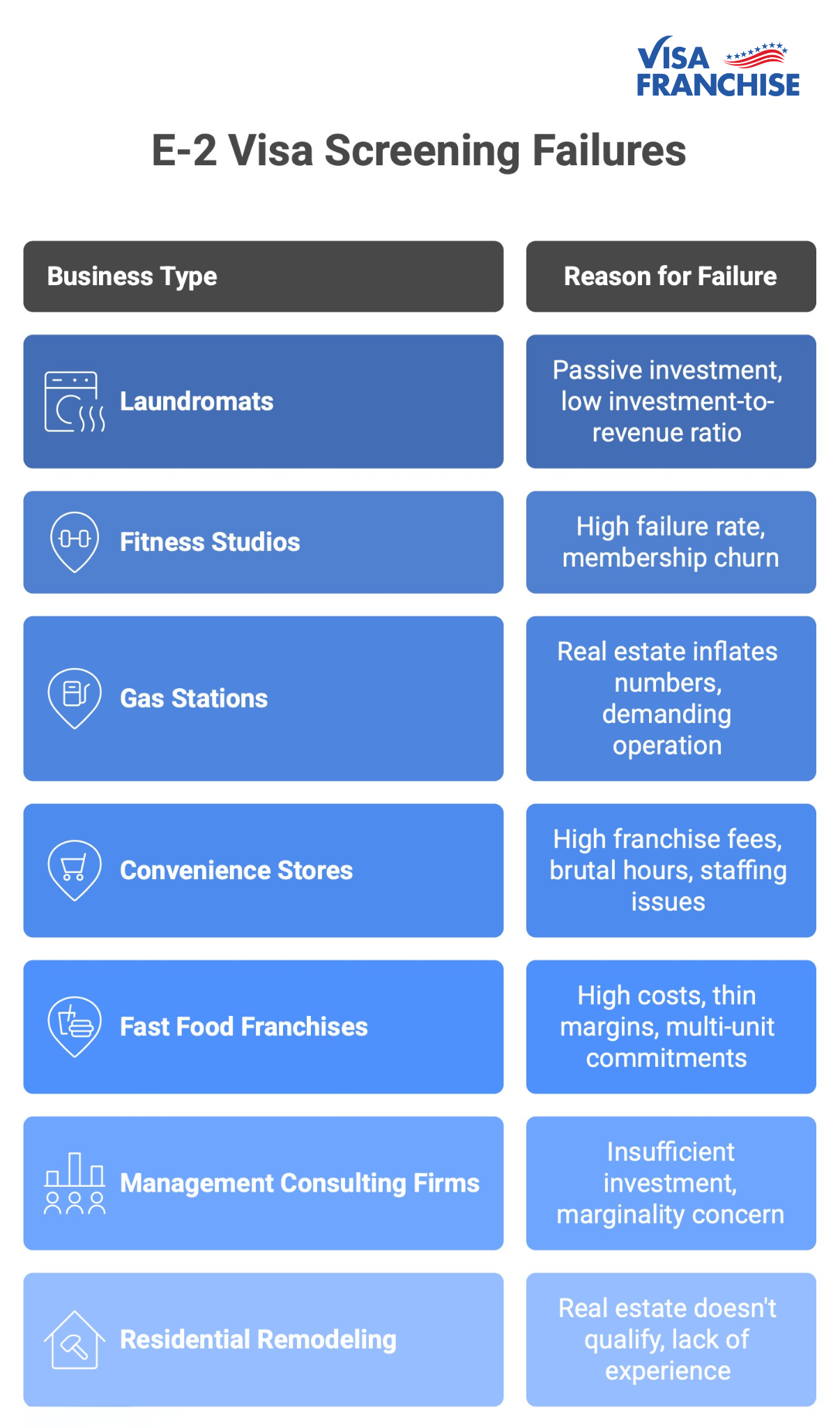
Why Laundromats Fail the E-2 Visa Investment Test
A laundromat looks like a classic small business investment on the surface. You buy the machines, sign a lease, and the quarters roll in. The problem is that this is exactly how consulate officers see it too: a passive investment, not an enterprise you are actively directing.
Most laundromats are highly automated, owner-absent operations. The investment-to-revenue ratio is low, employee headcount is minimal (often one or two part-time attendants), and the business does not lend itself to a narrative of an entrepreneur actively managing and developing an enterprise. Consulate officers across multiple U.S. embassies have denied E-2 petitions for laundromats on exactly these grounds.
Beyond the visa risk, the business itself is increasingly squeezed. Equipment maintenance costs are substantial. Commercial laundry app-based competitors are taking share in urban markets. And the investment required for a modern, well-equipped facility has climbed significantly while margins have not moved.
Fitness Studios and the E-2 Visa: Why They Don't Qualify
Fitness is one of the most popular franchise categories pitched to E-2 investors. It should not be.
The high-profile collapse of F45 Training is the clearest illustration of the risk. F45 was delisted from the NYSE in August 2023 after its share price fell by roughly 75%. In Australia alone, a restructuring firm identified 151 F45 franchises for sale simultaneously. Franchisees paid between $350,000 and $560,000 to open a studio. Many of them did not recover their investment.
F45 is not alone. The broader fitness franchise landscape has been brutal for investors. 9Round, the kickboxing franchise, went from 494 units in 2021 to 200 units by end of 2024, a loss of nearly 300 locations in three years. CycleBar dropped from 259 units to 189 over a single year. Title Boxing Club lost more than 50 net units between 2021 and 2024. Gold's Gym filed Chapter 11 bankruptcy. Blink Fitness, owned by Equinox, filed Chapter 11 in 2024. Honors Holdings, the largest Orangetheory franchisee with over 100 studios, collapsed into involuntary Chapter 7 bankruptcy proceedings. Xponential Fitness, the parent of CycleBar, StretchLab, Pure Barre, and others, has faced shareholder fraud class action lawsuits and investigations by the SEC and FTC.
The structural problem is not pandemic-related weakness. It is that fitness studios run on memberships. Memberships churn. When you lose a large portion of your member base, you do not recover quickly. Revenue drops immediately but your lease, payroll, and equipment loan payments do not. You are locked into high fixed costs with a variable and fickle revenue base.
For an E-2 investor, there is an additional layer of risk. If the business struggles in year one or two, your visa renewal is in jeopardy. A fitness studio that takes 18 months to build its membership base and breaks even in month 20 may not look like a viable enterprise at your first renewal.
Gas Stations and the E-2 Visa: When Real Estate Inflates the Numbers
Gas stations fail the E-2 investment test for a different reason than laundromats. The purchase price is high, often $1 million or more for a well-located station, but much of that value is tied up in real estate and fuel inventory. The U.S. consulate is assessing the investment in the business, not the real estate component. Stripping out the real estate often leaves a business investment that looks thin.
Operationally, gas stations are also extremely demanding. Margins on fuel are razor thin. The economics depend almost entirely on convenience store attached sales and the fuel volume driven by location. A first-time owner with no experience in the category, no existing supplier relationships, and no knowledge of the local competitive dynamics is at a significant disadvantage.
Beyond the visa and business challenges, gas stations carry environmental liability. Underground storage tanks are federally regulated. If there is contamination on the property, the owner bears significant remediation risk. This is not a business category I recommend any international investor enter without extensive prior experience in the sector.
Convenience Stores and the E-2 Visa Marginal Enterprise Test
Convenience stores share many of the same problems as gas stations, with a few added complications. The franchise fee and royalty structures for major convenience store brands are high. The hours are brutal: most locations operate 24 hours a day, seven days a week. Shrinkage (theft) is a constant operational challenge. And the category is under serious long-term competitive pressure from Amazon, grocery delivery, and dollar store expansion.
From an E-2 perspective, the bigger issue is staffing. Convenience stores often require multiple shift employees around the clock. Finding, training, and retaining reliable staff in this category is genuinely difficult. Labor cost overruns are one of the primary reasons convenience store operators fail in their first two years.
I have not seen a single convenience store E-2 petition from our client base that I would describe as straightforward. The investment structure, the owner's role, and the economics all require extensive documentation to present compellingly.
Fast Food Franchises and the E-2 Visa: High Costs, Thin Margins, and a High Bar
This one requires an important nuance. Fast food restaurants can work for E-2 investors. But the bar is higher than most people expect, and the business itself is less forgiving than the franchise marketing materials suggest.
The primary issue is that major fast food brands, McDonald's, Domino’s and Burger King, require multi-unit commitments, significant prior restaurant experience, or both. McDonald's does not sell single-unit franchises to first-time operators. Chick-fil-A retains ownership of the real estate and equipment, which creates complications for the E-2 investment structure.
For the fast food brands that do sell single-unit franchises to first-time operators, the economics are often poor. Labor costs are high and rising. Food cost pressures have increased significantly since 2022. Margins in fast food QSR (quick service restaurants) typically run 5 to 15 percent at the unit level after all costs. For an investment of $400,000 to $800,000, that is a long payback period. Not to mention 9-12+ month to source the location and build out the restaurant!
The E-2 also requires you to be the active operator of the business. Owning a fast food franchise and hiring a manager to run it while you live separately is not a strong E-2 petition.
Exception: If you have five or more years of restaurant management or ownership experience and can demonstrate direct operational knowledge of the QSR category, a well-selected fast food franchise can be structured for E-2 eligibility. The key is choosing a brand with a transparent Item 19, healthy unit economics, and no requirement for multi-unit commitment at the outset. Also if you are buying an existing, profitable restaurant you avoid the lengthy build out/permiting process.
Why Management Consulting Firms Fail the E-2 Visa Investment Test
This is the most common mistake made by international professionals coming from corporate careers. They have spent 15 or 20 years in consulting, banking, or finance. They believe their expertise is their product. They want to set up a U.S. consulting practice and bill clients for their knowledge.
The E-2 visa does not work that way.
The visa requires a substantial investment that is at risk. A consulting firm whose primary asset is the owner's expertise and whose startup costs are a laptop, a business registration, and a few months of office rent does not meet the investment test. Consulate officers see through this structure immediately. The investment is not proportional to the enterprise. There is nothing substantial at risk.
There is also the marginality concern. An E-2 business cannot exist solely to provide income for the owner and their family. It must have the capacity to create jobs beyond the owner. A solo consulting practice fails this test by design.
We have seen investors attempt to solve this by inflating their investment: leasing expensive office space, buying equipment they do not need, or prepaying vendors for services years in advance. This rarely works. Consulate officers evaluate the plausibility of the investment, not just the dollar amount. Probably better to go with the O-1A visa or another category if you would like to run a management consulting firm.
Residential Remodeling and the E-2 Visa: Why the Qualifying Investment Is Lower Than You Think
Residential remodeling is one of the most misunderstood categories in E-2 planning.
The first problem is what you can count as your investment. Real estate itself does not qualify for the E-2 visa. The land and the structure are not an investment in a business enterprise. What does qualify: furnishings, tools, contractor costs, permits, and other business expenses directly tied to operating the remodeling business. For most residential remodeling operations, that qualifying investment number is far lower than investors expect.
The second problem is experience. A remodeling business run by someone who has never flipped a home, never managed contractors, and never navigated U.S. building permits and code compliance is a very difficult petition to sustain. Consulate officers want to see that the owner has the background to actually operate the business. Without prior remodeling experience, the petition looks speculative and the operation likely to fail.
The third problem is timeline. Even if you do have the experience, building a remodeling business to a scale that demonstrates viability for E-2 renewal typically requires completing multiple projects and establishing a genuine track record. That takes time. Investors who need their visa within six to twelve months should look elsewhere.
Exception: If you have already completed one or two residential flips and can document your experience, a properly structured residential remodeling business can be built into a defensible E-2 case. The investment structure needs to exclude real estate value entirely and focus on qualifying business assets and working capital. This requires careful planning with an experienced immigration attorney from the start.
What to Do Instead
The businesses above share a common thread: they either fail the investment test, fail the active enterprise test, or carry operational risks that are disproportionately dangerous for an investor whose visa depends on the business succeeding.
The E-2 visa is designed for entrepreneurs and investors who are genuinely building a business in the United States. The strongest petitions come from people who have chosen a category they understand, invested at a level that is proportional to the business, and can demonstrate clearly that the enterprise will create jobs beyond the owner.
At Visa Franchise, we have helped hundreds of international investors identify and structure businesses that meet these criteria. Franchises in home services, senior care, pet care, and select food service categories consistently produce strong E-2 results when selected and structured correctly. We have also reviewed over 100 franchise brands and turned down dozens that would not serve our clients well, for exactly the reasons described in this article.
If you are exploring E-2 visa options and want to avoid the most common pitfalls, visit www.visafranchise.com. Our team reviews your background, budget, and goals before making any recommendations. The conversation is free. The mistakes, if you go it alone, are not.
Discover if you qualify to invest in a thriving U.S. franchise and secure your E-2 visa.
Check your eligibility
More Insights You Might Like
Explore related articles packed with expert advice, real stories, and practical tips to support your U.S. visa and relocation journey.