O-1 Visa Approval Rate 2025: Record Issuances and Who's Getting Them
The State Department published its FY2025 nonimmigrant visa statistics, and the O-1 numbers tell a different story than the E-2 data that got more attention. While E-2 issuances dipped, O-1 visa issuances reached 20,015 in fiscal year 2025, the highest total on record.
That record matters for anyone tracking the extraordinary ability visa program, because 2025 is not a good year to be making assumptions about U.S. immigration trends. Getting the actual numbers, and reading them correctly, is more useful than relying on anecdote or practitioner estimates.
This article covers the full FY2016–FY2025 dataset, country-by-country breakdowns, and a plain-language explanation of what "approval rate" actually means for O-1 applicants.
FY2025 O-1 Visa Numbers: A New All-Time Record
Total O-1 issuances in FY2025: 20,015. That is up from 19,457 in FY2024, which was itself the previous record. The program has now posted three consecutive years above 18,000, a threshold it had never crossed before FY2022.
Two ways to read this number:
- The program is not in contraction. Every year of concern about O-1 scrutiny, RFE rates, or policy tightening has still produced more total issuances.
- The growth is real but uneven. The UK, which has dominated the program for a decade, barely grew year-over-year. China and India, by contrast, posted multi-year gains that have reshaped the nationality distribution.
FY2025 is 25.7% above the FY2016 baseline of 15,918. COVID knocked the program to a low of 7,294 in FY2021. The recovery to record highs in FY2025 took four years.

Ten Years of O-1 Data: What the Trend Shows
The FY2016–FY2025 window breaks into three periods.
From FY2016 to FY2019, the program ran in a steady band between 15,918 and 17,751. Growth was modest, the UK held a dominant share, and year-to-year swings were small.
FY2020 and FY2021 were the COVID years. Issuances dropped to 8,838 in FY2020, then fell further to 7,294 in FY2021 as consulates remained limited and global travel was still constrained. That two-year trough represents a 58.9% decline from the FY2019 baseline.
The recovery from FY2022 onward has been sharp and sustained. FY2022 produced 19,102. A full reversal of the pandemic losses in a single year. FY2023 and FY2024 continued the climb, and FY2025 eclipsed both.
The ten-year average sits at approximately 16,028 issuances per year. FY2025 is 24.9% above that average. By any historical measure, the program is in a healthy period.
O-1 Visa by Country: Who Is Getting Approved
Nationality is the most useful lens for reading O-1 data, because the country breakdown reveals who is actually using the visa and how demand is shifting. The State Department data covers consular issuances only, meaning cases processed at U.S. embassies and consulates abroad.
United Kingdom: Still the Largest Single Source
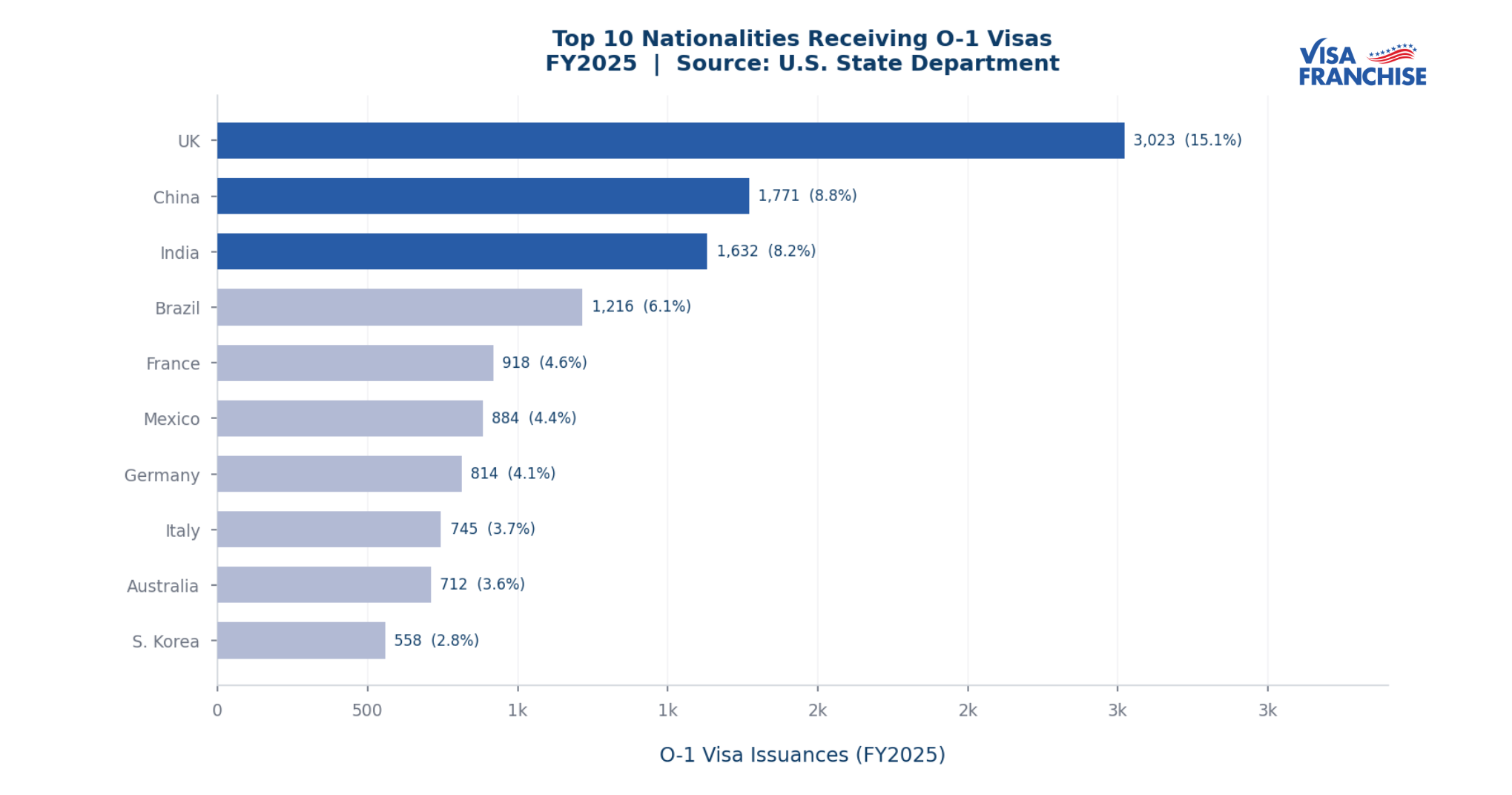
The UK issued 3,023 O-1 visas in FY2025, or 15.1% of the entire program. It has led the program in every year of this dataset. The FY2025 figure is up from 2,691 in FY2024, reversing a two-year dip from the FY2022 peak of 3,569.
The UK's dominance reflects decades of bilateral cultural and professional exchange with the United States: entertainment, finance, academia, and technology. O-1B (arts, entertainment, motion picture, TV) cases are particularly common among British nationals.
China and India: The Biggest Growth Stories
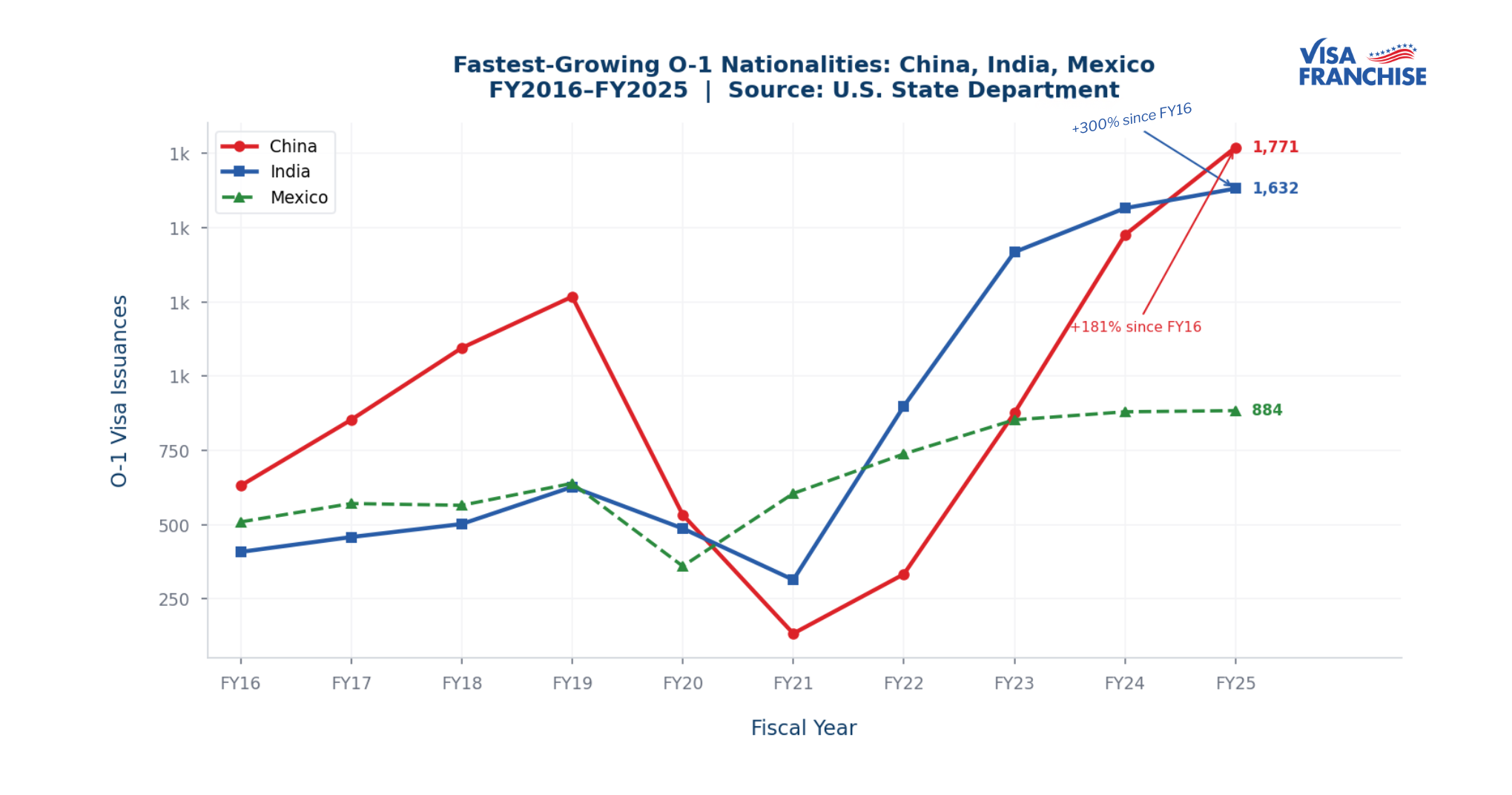
China grew from 631 issuances in FY2016 to 1,771 in FY2025, a 181% increase over the decade. India went from 408 to 1,632, a 300% increase. The largest percentage growth of any country in the top ten.
Both of these trends matter for a reason that is specific to the O-1 program: neither China nor India has an E-1/E-2 treaty with the United States.
That means entrepreneurs, investors, and business owners from these countries cannot use the treaty investor pathways. O-1A (the extraordinary ability category for science, business, education, and athletics) has become one of their primary nonimmigrant options for U.S.-bound professionals.
The growth in Chinese and Indian O-1 issuances tracks the expansion of the tech sector, startup ecosystem, and academic communities that overlap with those countries.
Founders, researchers, and senior engineers from both countries are increasingly using the O-1A as a work authorization pathway while pursuing EB-1A or other permanent residency options.
Brazil, Mexico, and the Americas
Brazil is the fourth-largest O-1 source country at 1,216 issuances in FY2025, though its growth over the decade has been flat. FY2016 produced 1,162, meaning a decade of absolute volume growth of just 4.6%. Like China and India, Brazil has no E-1/E-2 treaty, which makes O-1 a relevant pathway for Brazilian entrepreneurs and professionals.
Mexico grew more meaningfully, from 509 in FY2016 to 884 in FY2025, a 73.7% increase. Mexico does have E-1/E-2 treaty access, so O-1 issuances from Mexico reflect genuine extraordinary ability cases rather than treaty investor workarounds.
Europe: France, Germany, Italy, Spain
The mid-tier European countries. France (918), Germany (814), Italy (745), and Spain (540), all held relatively stable volumes over the decade, with no dramatic growth or decline. France is down slightly from its FY2016 level of 950; Germany is up 9.9% from 741.
These countries have E-1/E-2 treaty access, so their O-1 applicants are genuinely in the extraordinary ability category rather than using it as a treaty substitute.
USCIS adjudicators review the totality of the evidence. Three criteria met on paper is not always sufficient; the evidence must actually establish that the person is among the small percentage who has risen to the top. This is where the quality of the petition narrative and supporting documentation matters more than the raw count of exhibits.
Most O-1A petitions for tech founders, researchers, and executives are built around a combination of original contributions, critical role, high salary, and media coverage. Awards and memberships are the strongest criteria when available, but the program is designed to accommodate professionals whose work does not produce traditional academic credentials.
- Performance of a lead or starring role in productions or events with a distinguished reputation (primarily O-1B, but relevant to O-1A for athletics and certain business contexts)
- Command a high salary or remuneration for services, evidenced by contracts or other reliable evidence
- A critical or essential role at an organization that has a distinguished reputation
- Authorship of scholarly articles in professional or major trade publications or other major media
- Original contributions of major significance to your field, whether scientific, scholarly, artistic, athletic, or business-related
- Published material about you in professional or major trade publications, newspapers, or other major media
- Membership in an association that requires outstanding achievement as a condition of membership, as judged by recognized national or international experts
- Receipt of a nationally or internationally recognized prize or award for excellence in your field
For O-1A, USCIS requires evidence that you meet either a major international award, or at least three of the following eight criteria:
To qualify for an O-1 visa, a petitioner must demonstrate that you have risen to the top of your field. The standard for O-1A (science, education, business, athletics) is extraordinary ability evidenced by sustained national or international acclaim. For O-1B (arts, entertainment, film/TV), the standard is extraordinary achievement.
O-1 Visa Requirements: The Eight Evidentiary Criteria
O-1A vs O-1B: What the Difference Means for Applicants
O-1 visas split into two categories, and the distinction affects both the eligibility criteria and the petitioning strategy.
O-1A covers individuals with extraordinary ability in science, education, business, or athletics. The standard is demonstrating sustained national or international acclaim through evidence such as awards, publications, critical roles at distinguished organizations, high salary, or original contributions of major significance.
O-1B covers individuals with extraordinary ability in the arts, or in the motion picture and television industries.
The evidentiary criteria for arts and entertainment cases differ from O-1A and include things like lead or starring roles, reviews from critics, and commercial success.
The State Department does not publish separate issuance totals for O-1A and O-1B in its consular data. USCIS does publish petition-level approval rate data that distinguishes between the two, and the patterns differ.
O-1A petitions have historically carried higher scrutiny at USCIS, particularly in recent years, because of the volume of tech and startup cases where "extraordinary ability" in business is harder to document than a Grammy or an Olympic medal.
What Does the O-1 Visa Approval Rate Actually Mean?
The State Department's issuance data, which is the source for all figures in this article, tracks consular approvals. Cases where a consular officer at a U.S. embassy or consulate issued the O-1 visa. It does not capture denials, withdrawals, or cases processed domestically through USCIS change of status.
USCIS does publish petition-level approval data. Historically, O-1 petitions have run approval rates above 80% across the program. The 2023 USCIS report on STEM-related petition trends showed O-1A approval rates above 85% for most nationality groups, with higher rates for petitions accompanied by strong advisory opinions.
Common reasons for O-1 denials at USCIS include:
- Failure to meet the three-criterion minimum out of eight evidentiary criteria for O-1A
- Advisory opinion from a peer group or union that does not affirmatively support the claim
- Evidence that does not establish national or international level (state or regional recognition is not sufficient)
- Inconsistency between the work to be performed in the U.S. and the area of claimed extraordinary ability
At the consular level, denials are less common because the I-129 petition has already been approved by USCIS before the applicant goes to the embassy. Consular refusals typically involve administrative eligibility issues (nationality, visa overstays, inadmissibility grounds) rather than re-adjudication of the extraordinary ability standard.
O-1 Visa Processing Time in 2026
Processing time depends on whether you are filing through a U.S. consulate or through USCIS for change of status.
Consular Processing
Applicants outside the United States file the I-129 petition through USCIS first, then schedule a consular interview once the petition is approved. USCIS standard processing times for O-1 petitions currently run 3–5 months. After USCIS approval, consular interview wait times vary by post: major posts with high O-1 volume (London, Toronto, Mumbai, Sydney) typically have wait times of 2–8 weeks for nonimmigrant visa appointments.
USCIS Change of Status
Applicants already in the United States on another nonimmigrant visa can file Form I-129 to change status to O-1 without leaving the country. Current standard USCIS processing times for O-1 change of status are 3–6 months.
Premium processing is available for O-1 petitions under I-129. For an additional fee (currently $2,805 as of early 2026), USCIS guarantees a decision within 15 business days. Premium processing is widely used for O-1 cases because the turnaround makes planning significantly more predictable.
O-1 vs EB-1A: How the Two Pathways Relate
A common question from O-1 holders is how the visa relates to permanent residency. The short answer is that O-1A and EB-1A use similar evidentiary criteria, but they are separate processes with different standards.
O-1A is a nonimmigrant visa. It allows you to work in the U.S. for the duration of the approved petition (typically up to three years, renewable). It does not confer permanent residency or lead directly to a green card.
EB-1A is the first-preference employment-based immigrant category for aliens of extraordinary ability. It uses the same eight evidentiary criteria as O-1A. Many O-1A holders use their time in the U.S. to build the evidentiary record needed for EB-1A. Accumulating citations, awards, press coverage, and senior roles at major organizations.
One practical difference: EB-1A can be self-petitioned (no employer sponsor required), while O-1 requires a U.S. employer or agent as the petitioner. For entrepreneurs and freelancers, this means setting up a petitioning entity or working with an agent.
What This Data Means If You Are Planning to Apply
The FY2025 record of 20,015 issuances signals that the O-1 program is functioning at full capacity. The data does not show a program under restriction. What it does show is a program increasingly shaped by China and India applications in the tech, science, and business sectors.
Nationality matters less than it does for E-2, because O-1 is not treaty-based. Any nationality can apply, which is one of the program's most useful features for entrepreneurs from non-treaty countries.
The case quality standard remains the determinative factor. USCIS scrutiny on O-1A petitions has increased in recent years, particularly for cases where the extraordinary ability claim relies on salary, media coverage, or LinkedIn endorsements rather than peer-reviewed publications, industry awards, or leadership of distinguished organizations.
Applications with a strong advisory opinion, documented original contributions, and evidence of national or international recognition consistently outperform applications that rely on volume of evidence without a clear narrative.
Visa Franchise works with O-1A applicants who have business and investment backgrounds, helping them understand whether their profile supports an O-1 petition and whether the E-2 or another pathway might be more appropriate given their nationality, timeline, and long-term goals.
Frequently Asked Questions
How many O-1 visas are issued each year?
FY2025: 20,015 (all-time record). FY2024: 19,457. FY2023: 18,994. FY2022: 19,102. The decade average is approximately 16,028. The program hit its lowest point in FY2021 at 7,294 during COVID-related consular closures, and has grown in every year since.
What is the O-1 visa approval rate?
USCIS does not publish a single blanket approval rate for O-1 petitions. USCIS data on O-1A petitions has historically shown approval rates above 80–85% for well-prepared cases. The approval rate for consular issuances (at U.S. embassies abroad) is higher, because the USCIS petition approval is a prerequisite before the consular appointment.
Which country gets the most O-1 visas?
The UK has led O-1 issuances every year in this dataset. In FY2025, the UK received 3,023 O-1 visas, representing 15.1% of the total program. China (1,771) and India (1,632) are second and third, with both showing dramatic growth over the past decade.
Can entrepreneurs get an O-1 visa?
Yes, through the O-1A category, which covers extraordinary ability in business as well as science, education, and athletics. Entrepreneurs need to document their extraordinary ability through criteria such as major awards, original contributions of major significance, critical roles at distinguished organizations, or high salary relative to others in the field.
Founders and executives from countries without E-1/E-2 treaty access, such as China, India, and Brazil, frequently use O-1A as their primary nonimmigrant work authorization pathway.
How long does O-1 visa processing take in 2025?
Standard USCIS processing for O-1 petitions (Form I-129) currently runs 3–5 months. Premium processing, available for an additional fee, guarantees a USCIS decision within 15 business days. After USCIS approval, consular appointments at major posts typically add 2–8 weeks.
Total timeline from filing to visa issuance is commonly 4–7 months without premium processing, or 6–10 weeks with it.
Is the O-1 visa the same as the extraordinary ability green card?
No. The O-1 is a nonimmigrant visa that authorizes temporary work in the U.S. The EB-1A is the first-preference immigrant visa (green card category) for extraordinary ability. Both use similar eight-criterion evidentiary standards, and many O-1A holders transition to EB-1A petitions after building their U.S. track record.
O-1 does not automatically lead to a green card, but the two pathways are legally and strategically linked.
Why are India and China growing so fast in O-1 issuances?
Neither India nor China has an E-1 or E-2 bilateral investment treaty with the United States. That means entrepreneurs, investors, and senior professionals from both countries cannot use the treaty trader or treaty investor pathways. O-1A has become one of the few viable nonimmigrant work authorization options for high-level business and technology professionals from these countries.
The growth in O-1 issuances tracks the global expansion of their tech, academic, and startup communities.
Discover if you qualify to invest in a thriving U.S. franchise and secure your E-2 visa.
Check your eligibility
More Insights You Might Like
Explore related articles packed with expert advice, real stories, and practical tips to support your U.S. visa and relocation journey.